
|
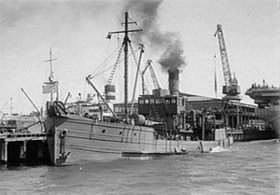
In the early 1940s, the North Coast Steam Navigation Company (NCSN Co), was in need of another vessel so an order was placed with E. Wright of Tuncurry, Shipbuilder. In 1942 the ship was completed and named Uralba. This was the last wooden coal burner built in Australia. The vessel still needed to be fitted out and subsequently was towed to Sydney. Here the Uralba was fitted with second hand machinery from the Ex-Sydney ferry Kuramia, an engine from the ferry Vaucluse, and the boiler from an old coaster called the Malachite.
|
| Uralba,
LaTrobe Picture Collection, State Library of Victoria |
Before the Uralba ever made a voyage for the NCSN Co, it was requestioned by the RAN on 13 July 1942. The Navy fitted out the Uralba to suit the task it was to perform; it was painted grey and armed with one 4 inch gun and one 20mm cannon. The Uralba was based in Brisbane at first, where it operated as an auxiliary boom defence vessel and minefield tender. In 1944 it was sent to Milne Bay, New Guinea. There the ship was used as an armament and stores carrier. After the war when the Navy no longer had a use for the Uralba, it was sent back to Sydney. In 1947 it was completely refitted under the supervision of the Navy and returned to the North Coast Steam Navigation Company.
The Uralba was used for coastal trade by the NCSN Co, but in less than six months work had run out and the Uralba was put up to be sold. The Uralba was the last vessel built for the North Coast Steam Navigation Company and shortly after the sale the company ceased operations.
At this time the State Electricity Commission (SEC) of Victoria was in need of a vessel to carry building materials from Tasmania to the mainland for the construction of the Latrobe Valley power stations. The Uralba seemed to be perfect, so after many negotiations a price was agreed upon. On 20 July 1948 the SEC took delivery of the Uralba for the amount of 30,000 pounds. The firm F.H. Stephens Pty Ltd was appointed as the managing agents for the vessel
|
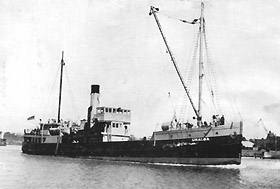
| S.S. Uralba,
MAAV Collection |
The Uralba made its first voyage for the SEC on 11 September 1948. In the three years that it served the SEC, it made a total of sixty four voyages. On each voyage it would bring back Tasmanian timber, cement and fibro-cement sheeting. On its return voyages, the Uralba generally carried cars, trucks and general goods to be sold in Tasmania. The SEC was pleased with the Uralba as it saved time and money on the construction program in the Latrobe Valley, although the crew was not of the same opinion. The ship apparently did not handle all too well in rough seas due to its flat bottom. The Captain had on many occasions requested the vessel be fitted with a bilge keel to offer some sort of stability. However, this was never done. In late 1951, the SEC had run out of need for the Uralba, and it was hired out for a period of eight months. It was later sold in September 1953 to the A & A Steamship Trading Syndicate of NSW for 12,500 pounds.
Little is documented on the Uralba from this date. We do know that in 1958 the High Court of Australia had taken possession of the vessel from the A & A Steamship Trading Syndicate and it was to be sold. The register was closed on 8 December
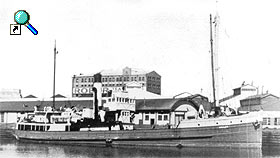
1958. On the 4 May 1960 the Uralba sank in the Maribyrnong. The owner at the time, Benny Gelbart of Footscray, had planned to convert the vessel to a cattle boat for use in the Northern Territory. The Uralba was raised, re-caulked and towed to a mooring opposite Charles Grimes Bridge on the Maribyrnong, where it stayed for several years. In 1964 the Uralba was purchased by Duncan & Russell Pty Ltd of Melbourne. Its engines where removed and was used as a dumb lighter.
|
| Uralba,
rigged as a coastal steamer. Photo courtesy Bob Leek |
On 5 November 1971 the Uralba was towed by the Fisheries and Wildlife Department to the Carrum Artificial Reef, and with the use of twenty sticks of gelignite was sent to its current resting place. Mr Alan Clark, in charge of towing the Uralba, stated that the amount of gelignite used to sink the vessel was far in excess of what was required. His personal view was that one stick would have done the job. As a result a large section of the keel and planking was blown out. Straight after the sinking Mr Clark dived on the Uralba and commented on the damage in the hold where part of the hull was missing. Timbers from the Uralba washed up on Melbourne beaches for weeks after. The Uralba is now home to a large number of fish and is occasionally visited by scuba divers who probably don't realise the vessel's colourful history.
Uralba Technical Details
-
Engine - Single Screw, Triple Expansion Engine 14" x 22.25" x 37". 21" Stroke, 81 HP.
Speed - 8 1/4 knots on trial. Average 7 knots. Engine Built 1914.
-
Coal Burner
Bunker Capacity - 75 tons, Consumption 10 1/2 tons per day.
-
Boiler - Muir & Huston, Single ended Scotch, 3 Furnaces, l60 lbs, Bower built 1894
-
Hull - Wooden Hull (Turpentine)
-
Carvel built
-
Straight Stem
-
Counter Stern
-
3 Bulk Heads
-
2 Masts
-
Tonnage - Gross 602.84 Net 312.14
-
Length - 154ft
-
Breadth - 36ft
-
Depth - 9ft 9in.
-
Hold Capacity l8,340 cu ft, Length 76ft
-
Water tanks 40ft x 60ft
-
2 x 10 tons Boiler feed tanks
-
4 x 8.5 tons Fresh water tanks
-
1 x 11.5 tons Fresh water tanks
- Do you have any comments or questions regarding the Uralba project report?
- If you have dived on the Uralba have you any comments concerning the site?
- Do you have any information / photographs historical or otherwise which you believe may be useful to the MAAV for inclusion in the project report?
- Full credit will be given to any material if published.
Your comments are appreciated.
References
SEC files and reports on the Uralba. Six volumes.
Personal communication with Mr Alan Clark.
North Coast Run by Mike Richards 2nd edition.
Port Phillip Shipwrecks Stage 3 by Leonie Foster, 1989
The Log, Volume 21, Number 4 November 1988 pp148
The Age Thursday 5 May 1960 pp3.
Australia's Ships of War by John
This site was constructed and is maintained
by Eric F. Langenberg.
The contents of this site - text, images, and data - are intended for
personal information only.
Written permission from the M.A.A.V. is
required for the publication of any material.
Any use of this
material should credit the Maritime Archaeology Association Of Victoria.
Copyright (c) 1999 : Maritime Archaeology Association Of Victoria, Inc. All rights reserved.
Last modified: February, 2011
|
|