|
||||||
|
|
||||||

|
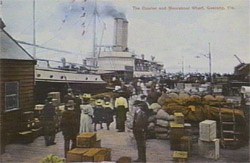
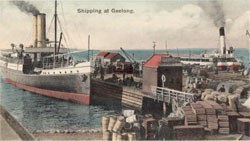
During the 1880s the Port Phillip Bay excursion steamers grew in popularity such that the Melbourne based company, Huddart Parker, commissioned the building of a new ship specifically for the trade. The new steamer was expected to take advantage of the increased trade and to compete with Howard Smith's Edina. The steel-hulled Courier, 728 tons, was launched in Scotland in 1887 and arrived in Melbourne at the end of the year to begin running in the Melbourne-Geelong trade in January 1888.
Unlike the Edina, the Courier had a relatively uneventful life, and remained in the Geelong trade until November 1927. Age and economics forced her withdrawal from service and inevitable sale to ship breakers. The hull was stripped of everything considered to be of value, then towed through The Heads on March 27 1928 and scuttled in the Ships' Graveyard. Today, the remains of the Courier lie in 42 metres of water and, as with many of the wrecks in the Ships' Graveyard, the hull has mostly collapsed. The bow and stern sections are lying over to starboard and are the best preserved parts of the hull. The fore deck still retains a considerable amount of planking, a few deck fittings and some railing on the starboard side. This deck area is quite large and is an impressive sight, standing approximately seven metres off the bottom. Immediately behind this, the hull has totally collapsed, leaving the main deck hatch coaming sitting on the bottom. Behind this are the two boilers sitting in line. On days with good visibility the dark shape of the stern can just be seen in the distance, although to see this close up requires a separate dive. The stem is also an impressive sight, but it is less structurally intact than the bow. The shape of the vessel's counter stern is still recognisable, and just forward of this, there is the remains of some superstructure.
References
Written permission from the M.A.A.V. is required for the publication of any material. Any use of this material should credit the Maritime Archaeology Association Of Victoria.
Last modified: April, 2010 |
|||||